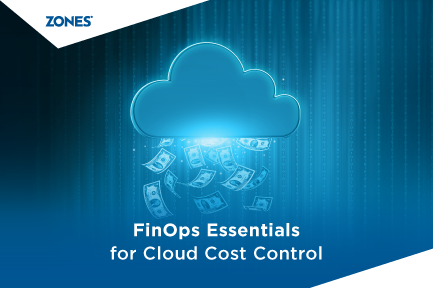
As organizations accelerate cloud adoption across regions, business units, and workloads, one challenge has become universal: managing cloud costs with predictability and control. Cloud brings scale, speed, and flexibility, but without financial governance, spending can increase quickly and unexpectedly. This is why businesses are adopting FinOps, a structured, cross-functional discipline designed to align cloud usage with financial accountability and business value.
This guide breaks down FinOps in a clear, beginner-friendly way while offering a practical view of how organizations can mature their cost optimization strategy.
Why FinOps, and why now?
Cloud cost is now an enterprise risk. Rapid provisioning, microservices, and experimental AI workloads can inflate spend overnight. The FinOps Foundation defines FinOps as a cultural and operational framework that brings engineering, finance, and product teams together to make data‑driven decisions about cloud spend. FinOps Foundation. Industry surveys show a majority of IT leaders struggle to forecast and control cloud costs, especially as usage patterns increase in complexity.
In simple terms, FinOps helps organizations:
- Gain full visibility into cloud consumption
- Optimize resources based on actual usage
- Forecast spend accurately
- Improve cost-to-performance ratios
- Make cloud decisions based on measurable business value
It is not a tool or a one-time exercise. FinOps is an ongoing discipline that becomes part of your operational model.
Core FinOps Principles
The first principle of FinOps is visibility. Every team needs a clear understanding of what is running in the cloud, who owns it, and how much it costs. This includes accurate tagging, workload mapping, real-time dashboards, and transparent reporting across business units and regions. Visibility builds the foundation for accurate decision-making because cost discussions are based on facts, not assumptions. Zones helps customers strengthen this foundation by providing unified cost and usage reporting across Azure, AWS, and GCP, making it easier for organizations to see trends, identify anomalies, and understand the true drivers of spend.
Once an organization has visibility into its cloud environment, it can begin identifying waste, right-sizing oversized resources, optimizing storage tiers, eliminating idle workloads, and choosing the most cost-efficient pricing models. Optimization is not a one-time activity. It is a continuous practice that ensures every resource delivers the right performance at the right cost. Zones supports customers in this stage through structured assessments, automation-led cleanup, and ongoing cost optimization within its managed services, enabling businesses to achieve measurable savings without disrupting operations.
Every resource in the cloud must have an owner, and every team must be responsible for the spend they generate. Accountability ensures cloud usage is intentional, documented, and tied to business value. It encourages engineering, finance, and leadership teams to collaborate on budgets, guardrails, and cloud governance policies. This shared ownership prevents overspending and helps organizations scale cloud environments responsibly. Zones helps reinforce accountability by establishing governance models, cost policies, and workload ownership structures that make it easier for global teams to manage cloud usage in a consistent and disciplined way.
How a mid-market company reduced cloud costs by 27%
A mid-market professional services company noticed their cloud bill increasing month after month, even though their workload growth was stable. Multiple teams were deploying resources without a common process, dev/test environments were often left running, and finance had limited visibility into usage patterns.
Zones Cloud experts began by creating a clear picture of the company’s Azure and AWS environments: mapping workloads, improving tagging, identifying owners, and consolidating cost data so both engineering and finance could see the same information. With visibility in place, the team focused on practical, low-disruption improvements such as right-sizing compute instances, shutting down idle resources, removing unused storage, and shifting certain workloads to more cost-efficient tiers.
These changes were implemented gradually and aligned with the company’s operations. As a result, they reduced unnecessary consumption by 27% while maintaining performance and gaining clearer predictability for future cloud spend.
Tools and automation to accelerate savings
Most cloud overspend comes from limited visibility and manual oversight. With the right tools and automation, organizations can accelerate savings by identifying underutilized resources, enforcing governance, and optimizing consumption continuously. Zones enables this through proactive monitoring, SOP-based processes, and “left-shift” operations that reduce costs by streamlining issue resolution. Automated dashboards, analytics, and governance checks across Azure, AWS, and GCP help customers uncover savings opportunities faster and maintain cost-efficient cloud environments.
Metrics That Validate Your FinOps Strategy
-
Percentage of cloud spend with an assigned owner
A higher percentage means accountability; aim for >90% within six months.
-
Reduction in untagged/orphaned resource spend
Track dollar impact monthly and target a steady decline as automations eliminate leaks.
-
Percentage of incidents where automation prevented wasted spend
Measure how often automation blocked or remediated potentially costly misconfigurations.
-
Forecast accuracy for monthly cloud spend
Improved forecasting reduces emergency budget reallocations; track variance against actuals.
-
Savings realized as a percentage of baseline spend
Report both absolute dollar savings and percentage reduction vs a defined baseline period.
How Zones Helps
Zones Cloud Experts supports customers with FinOps assessments, cost management operations, and automation accelerators that make this playbook easier to adopt and scale across the organization. Our engagement model includes:
- Clear visibility across Azure, AWS, and GCP through unified dashboards, tagging improvements, and workload mapping.
- Optimization opportunities such as right-sizing, storage tier alignment, idle resource cleanup, and platform hardening.
- Proactive monitoring, dashboard analytics, and 24x7 support to maintain cost-efficient, compliant cloud environments.
- Applies “left-shift” operations and SOP-based processes to reduce operational costs and improve resolution times.
- Cloud governance models, cost policies, and accountability frameworks so teams can manage spend consistently.
Frequently Asked Questions (FAQs)
1. Why do organizations struggle with cloud costs?
Because cloud is decentralized. Different teams deploy resources independently, usage varies by time zone, and spend becomes hard to track. FinOps fixes that with shared visibility and accountability.
2. We already monitor costs in our cloud portal. Isn’t that enough?
Monitoring is just one part. FinOps adds governance, forecasting, optimization, and ongoing collaboration between engineering and finance.
3. How long does it take to see value from FinOps?
Most companies see early improvements within weeks — starting with unused resources, right-sizing, and basic governance. Financial efficiency (20–30% savings) happens gradually over months as practices mature.
4. How does Zones support FinOps for multinational or distributed teams?
Zones brings a unified framework with global visibility, cost governance, automation, and 24/7 cloud operations ensuring teams across regions operate with a single source of truth.
5. What kind of outcomes do Zones customers typically see?
Better forecasting, stronger governance, higher performance and most importantly:
· 20–30% reduction in cloud consumption costs
· Improved operational stability
· Fewer surprise bills
· A cloud environment that grows with the business, not ahead of it
 Zones
Zones
 Zones : May 31, 2024, 11:13:04 AM